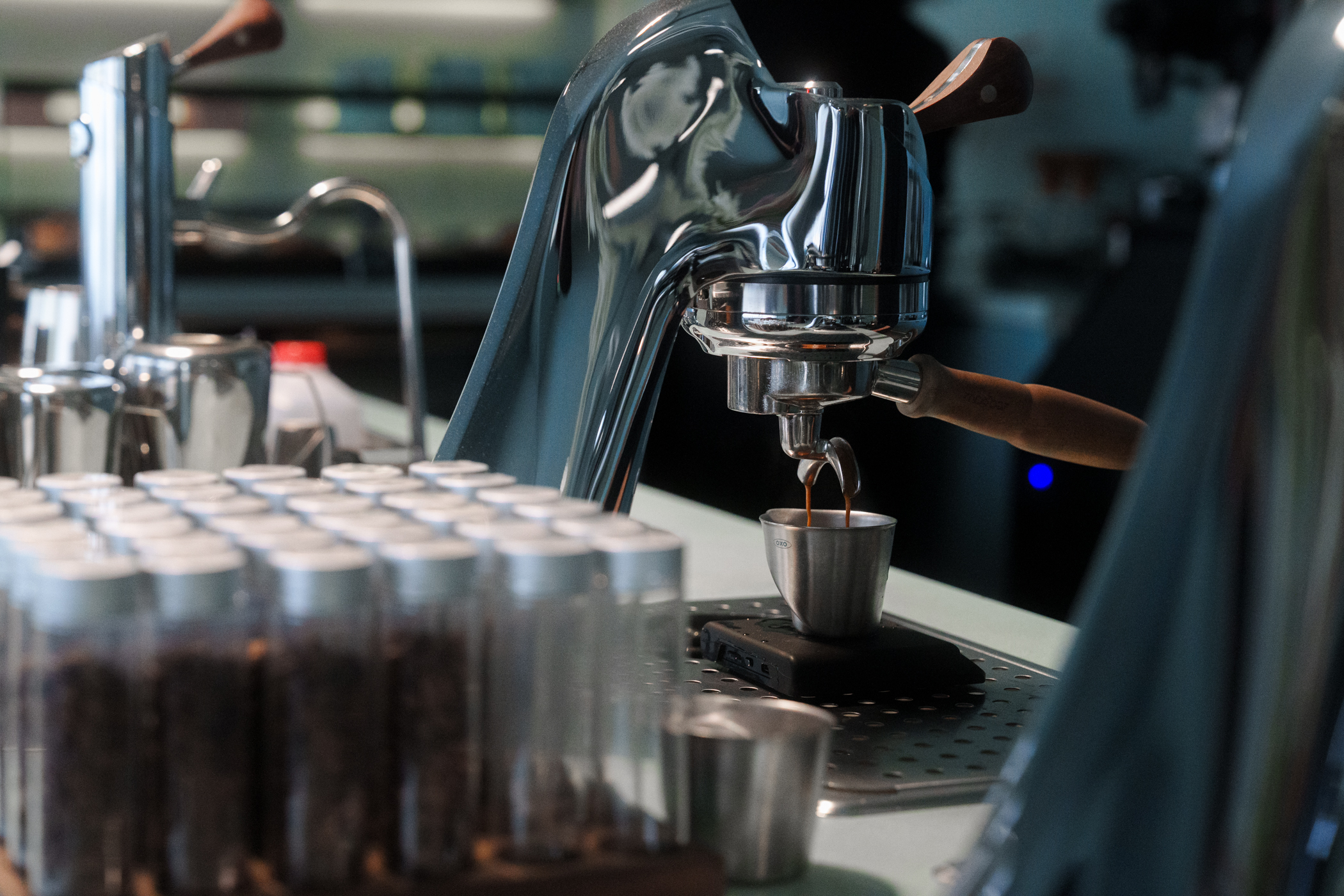
In the mid-2000s, La Marzocco identified an issue. After years spent perfecting temperature and pressure precision in their espresso machines, there was one final part that wasn’t delivering the espresso quality that the research and development team wanted: the espresso filter basket. When the team imagined everything that went into designing and manufacturing a machine, every espresso shot’s flavor came down to just 30 seconds of brew time inside that basket.
“At the time, it was not possible to create something that was consistent from basket to basket,” says La Marzocco R&D Manager Riccardo Gatti. The team had started to see that variance in basket manufacturing led to inconsistent shots on the bar. “We noticed that even the smallest difference in hole size meant that baristas could not pull the same exact shot on both of their machines’ group heads,” he added. The plan was set: in order to deliver true espresso quality, La Marzocco needed to redesign its espresso filter baskets.
Designing a Scanner
Espresso quality wasn’t going to be the tricky part—with enough testing, Gatti was sure the team could come up with parameters that pulled the exact shot they wanted. They even felt confident that they could present those specifications to a factory that could produce the design they wanted. The hardest part was measuring each basket quickly enough for precision on a production line. After all, with so much pressure and such a short brew time, every single hole at the bottom of the filter basket could affect shot quality if it were irregularly shaped or partially blocked.
With that in mind, La Marzocco teamed up with Vince Fedele of VST, who had been promoting the use of refractometers for measuring coffee concentration. As a specialty coffee consumer, Fedele had noticed inconsistencies at his favorite coffee bar. When he looked at the equipment, he also identified the basket as a potential issue. After running espresso samples through his refractometer, he could even show that the espresso shots themselves had different concentrations—the basket variance had affected the extraction drastically.
As a researcher and inventor, Fedele had developed a scanning technology that could take an instant snapshot of microscopic holes and measure their total surface area. It just so happens that his love of espresso made him a perfect fit for this scanner. With Fedele’s snapshot technology, La Marzocco developed a machine that could instantly measure both the total dimensions of the espresso basket and the total surface area of its holes. Knowing they could instantly measure each basket for consistency while on the production line, La Marzocco set to work in identifying the perfect parameters.
Developing the Perfect Dimensions
In La Marzocco’s R&D lab in Florence, the team pulled thousands of shots across dozens of prototypes. Using a coffee refractometer also helped measure consistency between each shot. “We needed to define the proper diameter for each hole at the bottom of the basket,” says Gatti. “By checking with the refractometer, we could see how different diameter sizes allowed for different extraction rates.” But the size of each hole wasn’t the only calculation needed. The team also needed to measure the proper bed depth of the coffee and scale each basket size appropriately. That means the 14-gram, 15-gram, and 21-gram baskets are all based on the same extraction geometry, and that their holes are sized appropriately for each basket so the proper grind size can extract coffee within the right time window.
It was also important for La Marzocco to define the ideal headspace in each basket. As water saturates a coffee puck, the coffee itself expands to fill the space. Too much headspace, and the water would channel through the puck, extracting the coffee unevenly. Not enough headspace, and the water would channel around the outside of the puck. This research allowed the R&D team the proper time and environment to study coffee saturation and its impact on extraction and channeling, leading to a ridged basket design to help people understand how much coffee should be used for each espresso shot and how much head space each tamped puck needed.
Production and Beyond
With the perfect basket design in place and a machine able to measure every part of the basket in a brief snapshot, it was time to roll out production. The initial run of baskets was produced to ship with every La Marzocco Strada EP, which was a brand-new precision espresso machine released in 2009. VST launched its own retail version for direct purchase, and by 2011, every La Marzocco espresso machine shipped with the new precision espresso baskets.
To this day, La Marzocco and VST espresso baskets are the only baskets available that are screened for precision using an imaging system to ensure consistency and quality. Even though it’s just a small part of the espresso machine, the entire quality of an espresso from seed to cup relies on those final thirty seconds in the filter basket. By ensuring every basket meets intense quality standards, every shot pulled on a La Marzocco has the full potential to be excellent.